Saturday, May 28, 2011
BLOWN OUT
Two words for this long weekend, BLOWN OUT. All the rivers in central Pa got a heavy dumping of rain yesterday. The Little J was holding out, but now it is at 4000 CFS. Any chance of fishing looks to be out the door and Monday might be OK for some thing.

Sunday, May 22, 2011
2011-05-22 Spring Creek
From TCO's stream conditions spring creek was about 390 CFS and it was going to be brown. When I got there it was high, but it was starting to clear. There were cars around, but I only saw a couple of people with rods all morning. I took a couple of photos of the creek so you can see what to expect from 390 CFS flows.

 To start out, I tied on a size 14 green wolf and a size 16 scud as a dropper. For the first hour I had only seen a few fish stalking close to shore, although I did get one to come up and look at the dry midstream. So I decided to go to a black woolly bugger which I do not typically fish, but this was the best time to throw them out and see how to use them. There were a few follows, but no solid chasers. One guy I talked to said he had 12 takes on a black streamer and rolled about 5 other fish. After about an hour of throwing a streamer I changed to a size 14 caddis and a tungsten bead head size 16 hare's ear on about 1.5 ft of x6 tippet. Also there was more sun out and the air temperature was warming up. With this combo I pulled in four browns and a nice rainbow (really bad photo of the rainbow).


With the sun and an increase in the air temperature there were a few mayflys out, but not enough to start the trout rising.


I did see my first snake of the summer and it had to be right next to were I had snagged my line.

Still a very good day on spring creek even though it was high and brown.

 To start out, I tied on a size 14 green wolf and a size 16 scud as a dropper. For the first hour I had only seen a few fish stalking close to shore, although I did get one to come up and look at the dry midstream. So I decided to go to a black woolly bugger which I do not typically fish, but this was the best time to throw them out and see how to use them. There were a few follows, but no solid chasers. One guy I talked to said he had 12 takes on a black streamer and rolled about 5 other fish. After about an hour of throwing a streamer I changed to a size 14 caddis and a tungsten bead head size 16 hare's ear on about 1.5 ft of x6 tippet. Also there was more sun out and the air temperature was warming up. With this combo I pulled in four browns and a nice rainbow (really bad photo of the rainbow).


With the sun and an increase in the air temperature there were a few mayflys out, but not enough to start the trout rising.


I did see my first snake of the summer and it had to be right next to were I had snagged my line.

Still a very good day on spring creek even though it was high and brown.
Saturday, May 21, 2011
Scud Step-by-Step
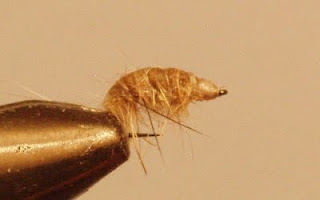
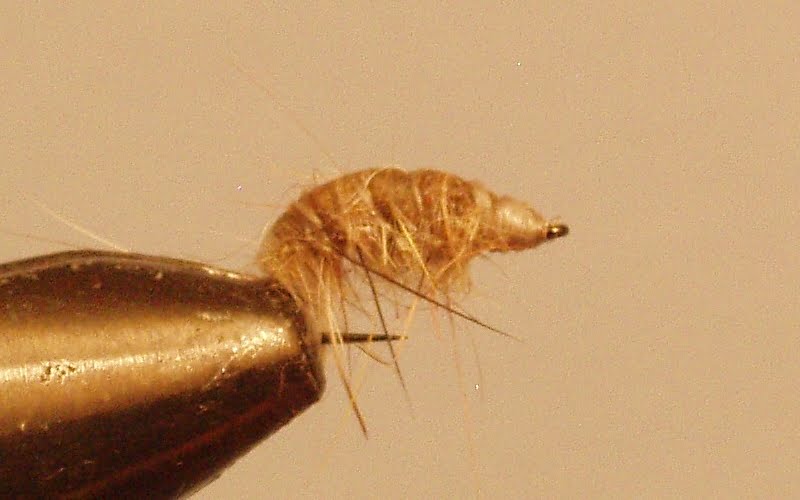
This is my typical go to fly on spring creek, size 16 scud. To fish this, I suspend it under a dry fly on a size x5 tippet, the length of the tippet will depend on the depth of the water; however I typically use 1-2 feet to begin with and adjust it from there.
Step 1 - Lay down a layer of sticky back lead, multiple applications can be used to get the right weight.

Step 2 - Tie on the tying thread (Rusty Dun was used here), leave about 3-4 inches of waste to use as the ribbing. Lay down enough thread to make a smooth body.

Step 3 - Tie in a strip of clear coloured surgical glove - 2 mm wide and longer enough to cover the length of the hook.

Step 4 - Loosely dub the thread with hares ear dubbing, or similar dubbing, and cover the entire hook to build the scud body.

Step 5 - Pull over the glove and tie down.
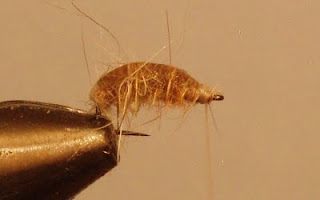
Step 6 - Rib the body with the waste tying thread and whip finish the tail. If you want, some wood duck or partridge fibers can be tied in over the hook eye to represent tails.

Step 7 - The final step is to pull out some of the dubbing to make it more leggy.
Step 1 - Lay down a layer of sticky back lead, multiple applications can be used to get the right weight.

Step 2 - Tie on the tying thread (Rusty Dun was used here), leave about 3-4 inches of waste to use as the ribbing. Lay down enough thread to make a smooth body.

Step 3 - Tie in a strip of clear coloured surgical glove - 2 mm wide and longer enough to cover the length of the hook.

Step 4 - Loosely dub the thread with hares ear dubbing, or similar dubbing, and cover the entire hook to build the scud body.

Step 5 - Pull over the glove and tie down.

Step 6 - Rib the body with the waste tying thread and whip finish the tail. If you want, some wood duck or partridge fibers can be tied in over the hook eye to represent tails.

Step 7 - The final step is to pull out some of the dubbing to make it more leggy.
Monday, May 16, 2011
Flies for fun
Decided to see if I could improve my ability to tie some semi-realistic flies. These guys were all thread, peacock herl and x8 tippet.


Sunday, May 15, 2011
2011-05-14 Spring Creek and Little Juniata
Finally, I have expanded my fishing area past Spring Creek. A graduating friend was in town for the weekend so we went out and hit spring creek in the morning and the Little Juniata (LJ) in the afternoon.
Spring creek was pretty void of anglers and trout when we were there, but I was able to get a few (3 to be exact) on a size 16 scud. The top water bug life was not great and we were only in the paradise section.
I have never been to the LJ, but from the forums I was hearing that we should get into some sulphurs. Not totally sure where we were, as I was getting told the directions as I was driving, but I know it was in the Rothrock State Forest, near Barree, at the end of road with a car park full of people. About 4-5 left hand turns after the low one way bridge.
After a short walk in we were on the river, which was 53F (water temp) when we got there and looked ok for wet wading. We were told on the hike in that fish were being taken on caddis nymphs, but no really hatch was happening. However, that was to change pretty quickly. With in an hour, so around 5pm, sulphurs were coming off and the section that we were in started to see a steady rise of trout. They were big splashy rises so on with the size 16 sulphur emerger. Over a period of 2 hours I was able to get 5 brownies all on the surface. I fouled hooked one and it would not stop fighting, but was a really decent size and dwarfed the other fish I landed. I also took one dunk in the water from the slippery rocks and it did make the drive home uncomfortable. My friend got a couple to the net, which was a pleasure to see as he was yet to catch a trout in PA.
All in all it was a good day out and I have the bruised knees to show for it.


Spring creek was pretty void of anglers and trout when we were there, but I was able to get a few (3 to be exact) on a size 16 scud. The top water bug life was not great and we were only in the paradise section.
I have never been to the LJ, but from the forums I was hearing that we should get into some sulphurs. Not totally sure where we were, as I was getting told the directions as I was driving, but I know it was in the Rothrock State Forest, near Barree, at the end of road with a car park full of people. About 4-5 left hand turns after the low one way bridge.
After a short walk in we were on the river, which was 53F (water temp) when we got there and looked ok for wet wading. We were told on the hike in that fish were being taken on caddis nymphs, but no really hatch was happening. However, that was to change pretty quickly. With in an hour, so around 5pm, sulphurs were coming off and the section that we were in started to see a steady rise of trout. They were big splashy rises so on with the size 16 sulphur emerger. Over a period of 2 hours I was able to get 5 brownies all on the surface. I fouled hooked one and it would not stop fighting, but was a really decent size and dwarfed the other fish I landed. I also took one dunk in the water from the slippery rocks and it did make the drive home uncomfortable. My friend got a couple to the net, which was a pleasure to see as he was yet to catch a trout in PA.
All in all it was a good day out and I have the bruised knees to show for it.


Sunday, May 8, 2011
Sulphur Nymph
Materials list:
Weight - Stick back lead
Hook – size 16 nymph hook
Tail – pheasant tail
Nymph Body – Embroidery thread – yellow and brown or two shades of yellow
Under Body – Hare Ear dubbingWings Casing – pheasant tail
Legs - Feather from a Mallard
 Step 1 - Place the hook in the vice and apply a layer of stick back lead with a double wrap near the head of the fly.
 Step 2 - Tie in ~3-4 pheasant tail fibers.
 Step 3 - Tie in the weaving thread on the sides of the fly and tie off the tying thread.
 Step 4 - Weave the body about half the length of the fly using the knot weave, here I was alternating the colour that went in front of the other to get a stripped look.
 Step 5 - Retie on the tying thread and tie down the weaving threads and remove the waste. Tie in ~6 pheasant tail fibers.
 Step 6 - Dub the body of the fly, I did not go back far enough so there looks to be a disjoint in the fly which should not be there.
 Step 7 - Take the mallard feather and cut a notch to form legs on either side of the fly, tie on the legs and remove the waste.
 Step 8 - pull the wing casing forward and tie down. You can either remove the waste else I have split the waste and done a figure 8 around them to make eyes for the nymph.
 Step 9 - Whip finish the tying thread behind the eyes and cut off the waste and shorten the pheasant tail to make the eyes. Apply head cement to finish the fly
Morel Season
Just what you need after a long day in the river, Morels. I have never been one for hunting for fungi, mainly due to the issue with eating something that might kill you. But Morel's seem to look very unique and therefore easy to determine. Although very hard to find. This is the loot from our first hunt, it started out fast with a few in 5 mins, but then the odd one or two before hitting a patch of five. All in all we got 11 morels for a 30 min walk.


Subscribe to:
Posts (Atom)